Signed in
filler@godaddy.com
- Home
- INTO STABILITY
- FOREWORD
- INTRODUCTION
- 1: ST LOUIS
- 2. SCHENECTADY
- 3. GE'S ADVANCED COURSE
- 4. GRAPHICAL ANAL. PAPER
- 5. NORTH AMER. AVIATION
- 6 AEROPHYSICS LAB
- 7: THE SPIRULE
- 8. THE ROOT LOCUS PAPER
- 9. TEXTBOOK
- 10. AUTONETICS
- 11. THE SPIRULE COMPANY
- EPILOGUE
- AFTERWORD
- ARTWORK
- BONUS CONTENT FOR FAMILY
- ROOT LOCUS EXPLANATIONS
- PRODUCTS
- Blank
Historical ROOT LOCUS Series:
Each of these PDF files draws upon the same body of research that went into the book, Into Stability. Eacg articlec focuses on one aspect of the development of Evans' Root-Locus Method
Evans_1_Introduction to Historical Root-Locus Method Series (pdf)
DownloadEvans_2_The Origins of the Root Locus Method (pdf)
DownloadEvans_3_The Aerophysics Lab at North American Aviation (pdf)
DownloadEvans_4_The Struggle to Publish the Root-Locus Method (pdf)
DownloadEvans_5_The Spirule (pdf)
DownloadEvans_6_Control-System Dynamics (pdf)
DownloadEvans_7_Into Stability (thru Chapter 1) (pdf)
Download1987 ASME Oldenburger Medal (pdf)
DownloadBringing Root Locus to Classroom. 1948-1954 (pdf)
DownloadThe Walter Evans Gallery
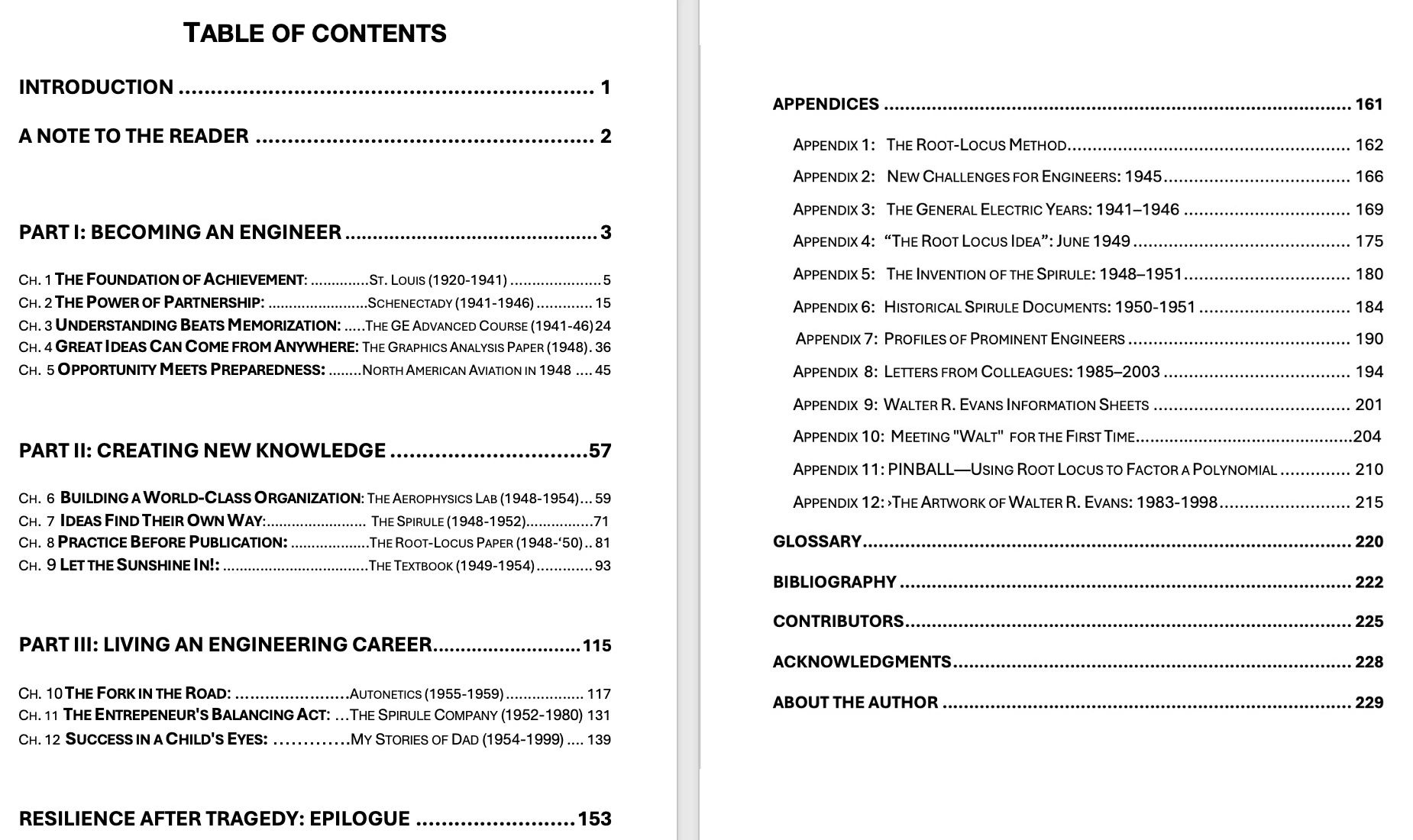
INTO STABILITY (SECOND EDITION) TABLE OF CONTENTS
.
NEW INTRODUCTION FOR THE 2nd EDITION
Imagine trying to balance a broomstick upright in your palm. The moment it begins to fall, your hand moves to catch it—not once, but continuously. That quiet cycle of sensing, correcting, and trying again is the essence of a servomechanism, the invisible control logic behind autopilots, guided missiles, thermostats, and countless modern machines.
Into Stability takes its title from this perpetual movement toward balance: not a destination of stillness, but an ongoing pursuit. The title reflects both a technical journey and a human one: the story of how engineers learned to design stability—and of the man who helped make that possible. Before Walter Evans developed the root-locus method, designing a stable control system was often a frustrating process of calculation, guesswork, and trial-and-error. Engineers could measure whether a system seemed stable, but they had little intuition for why it behaved the way it did—or how to improve it quickly.
Evans changed that. Root locus gave engineers a way to see stability. Instead of staring at equations, they could watch how a system’s behavior would change as they adjusted a design. It was like moving from reading weather statistics to seeing a storm track on a map. For the first time, engineers could predict answers to questions such as will this airplane autopilot settle down smoothly or oscillate? Will this machine recover from a disturbance—or spin out of control?
Most importantly, root locus helped engineers design better systems faster. (See Appendix 1.) Rather than building and testing endless variations, they could visualize likely outcomes before hardware was built, saving time and improving reliability. The method became one of the foundational tools of modern control engineering, helping engineers create stable, responsive systems used in aircraft, spacecraft, industrial machinery, medical devices, and countless technologies where dependable automatic control matters. This book tells the story of how Walter Evans helped engineers see stability—and how the experiences, mentors, friendships, and family that shaped him made that achievement possible.
NEW NOTE TO READER FOR THE 2nd EDITION
This book can be enjoyed on two levels.
It is, first, the story of Walter R. Evans and the invention of the root-locus method, one of the seminal developments in modern control engineering.
It is also an exploration of questions that every engineer eventually encounters. How does innovation begin? What role do mentors play? Why are important ideas often resisted? How does a profession recognize and disseminate new knowledge? What kind of culture encourages innovation? When should an engineer remain a technical contributor, and when should one become a manager? How do engineers balance professional achievement with entrepreneurship, family, leadership, and resilience?
Walter Evans's life does not provide theanswers to these questions, but it offers one engineer's remarkable journey through them.
The chapter titles reflect those broader themes. I hope you'll enjoy this book not only as the story of an important engineering achievement, but also as a reflection on the engineering profession and an invitation to reflect on your own journey as an engineer.
FOR A LIMITED TIME: through october: $50 VALUE - FREE TO E
Instructors:
what you may receive by mail
PAPERBACK copy of 2ND EDITION OF THE BOOK, aN original spirule, and a "slightly cubic" exercise: solve the first root-locus problem.
who is eligibile:
UP TO 50 instuctors of FALL 2026 college-level
courses for which the root-locus method IS listed in the catalog sylLabus.
21 PACKAGES HAVE already BEEN sent.
INTERESTED? EMAIL:
Questions? JUST Send an e-mail to gregorywalterevans@gmail.com
APP. 10 IN 2ND EDITION: MEETING WALT EVANS FOR FIRST TIME.

Our Mission
At Into Stability: Walter R Evans and the Story of Root Locus, we are on a mission to help people discover the joy of reading. We believe that reading is not only a source of entertainment but also a way to learn, grow, and connect with others.
Copyright © 2025 Realizing Root Locus - All Rights Reserved. QUESTIONS OR COMMENTS? SEND ME AN EMAIL GREGORYWALTEREVANS@GMAIL.COM
This website uses cookies.
We use cookies to analyze website traffic and optimize your website experience. By accepting our use of cookies, your data will be aggregated with all other user data.